
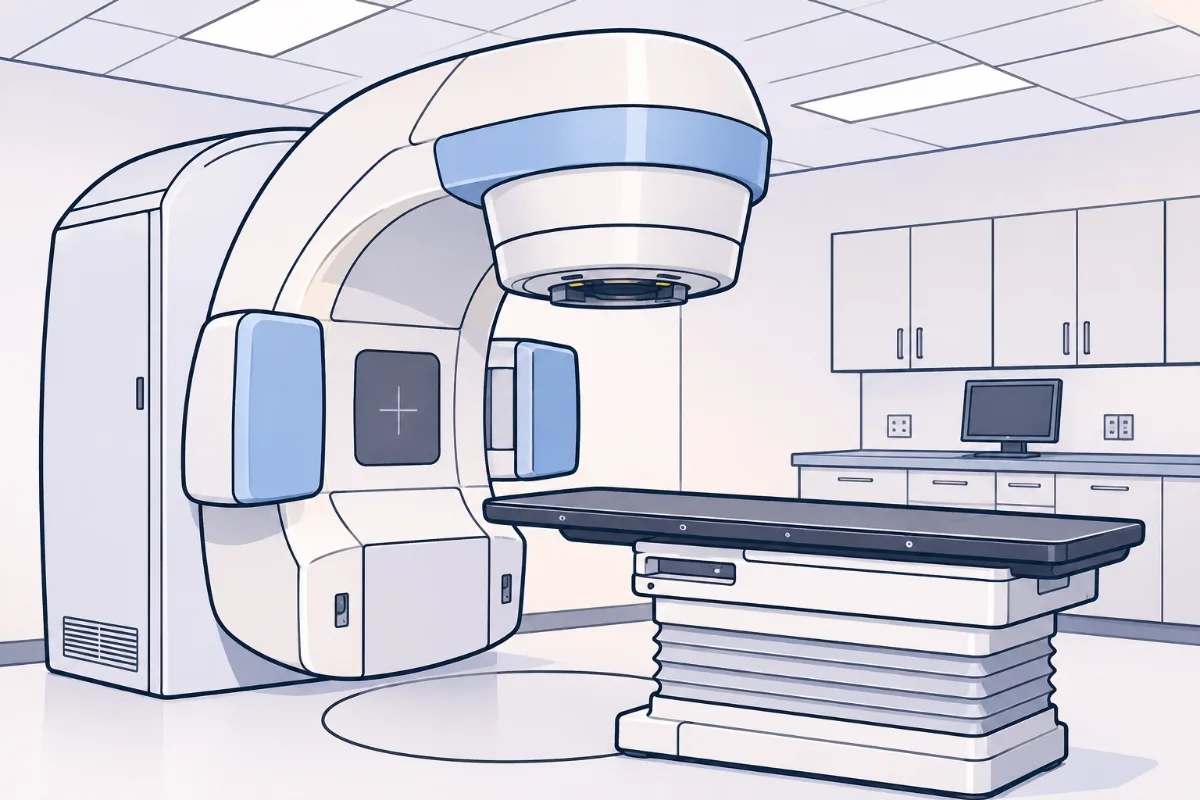
Getting a linac into or out of a vault is mostly a planning job. The machine is heavy, the parts aren’t cheap, and the building is usually what gets in the way. When a job runs long, it’s rarely the linac’s fault. It’s the floor, the doorway, or the power.
CUSTOMER TESTIMONIAL
“We had a hard deadline to clear the space, and 43 Oncology handled it. When they found a structural issue with the flooring, they didn’t cut corners or push the risk onto us — they investigated it, reinforced it, and kept us informed the whole way. Their crew worked late to hold our date, and everything came out clean. I’d recommend them to any facility facing a removal on a tight timeline.”
What Deinstallation Involves
Figure on three days for a full-room decommission, give or take. The linac comes out, along with the wall plates and cabling if the job needs them. Modulators, consoles, and spare parts get palletized and wrapped. Before anything moves, we walk the exit path.
What Installation Involves
Run the removal story in reverse. A gantry is just as heavy going in, so the floor has to be ready, the path from the dock to the vault measured, and the power and cooling in place. Once the machine is in the vault, we assemble and align it, and then the physics team takes over for commissioning.
When the Floor Is the Problem: A One-Week Removal
This one ran a week, and the reason had nothing to do with the linear accelerator.
When our team arrived to walk the site for a full clear-out of a Varian Silhouette, along with a CT simulator, wall plates, and backing, we noticed right away that the exit path ran across roughly sixteen feet of unreinforced wooden flooring. A Silhouette gantry runs in the neighborhood of ten to eleven thousand pounds. That floor was not going to hold it.
Nobody likes cutting into a floor, but it beats finding out mid-move that it won’t hold. Our engineers opened an inspection hole and looked at the framing. Once they knew how the load would travel through it, they shored the span. Only then did anything roll. We worked the plan through with the owner and the physician on site, so the timeline was settled.
With the path sound, the work went the way it should. The CT came out first, then the linac. Modulators, consoles, and spare parts were palletized and wrapped. Our crews kept going until eleven at night to meet the client’s deadline, and everything shipped to our warehouse in Perris, California, where it’s racked and ready for reinstallation.
Every site has surprises. The trick is to catch them early, fix them properly, and still make the date.
Planning an installation or a removal? Send us the make and model, where it is, and the date you need it done.