
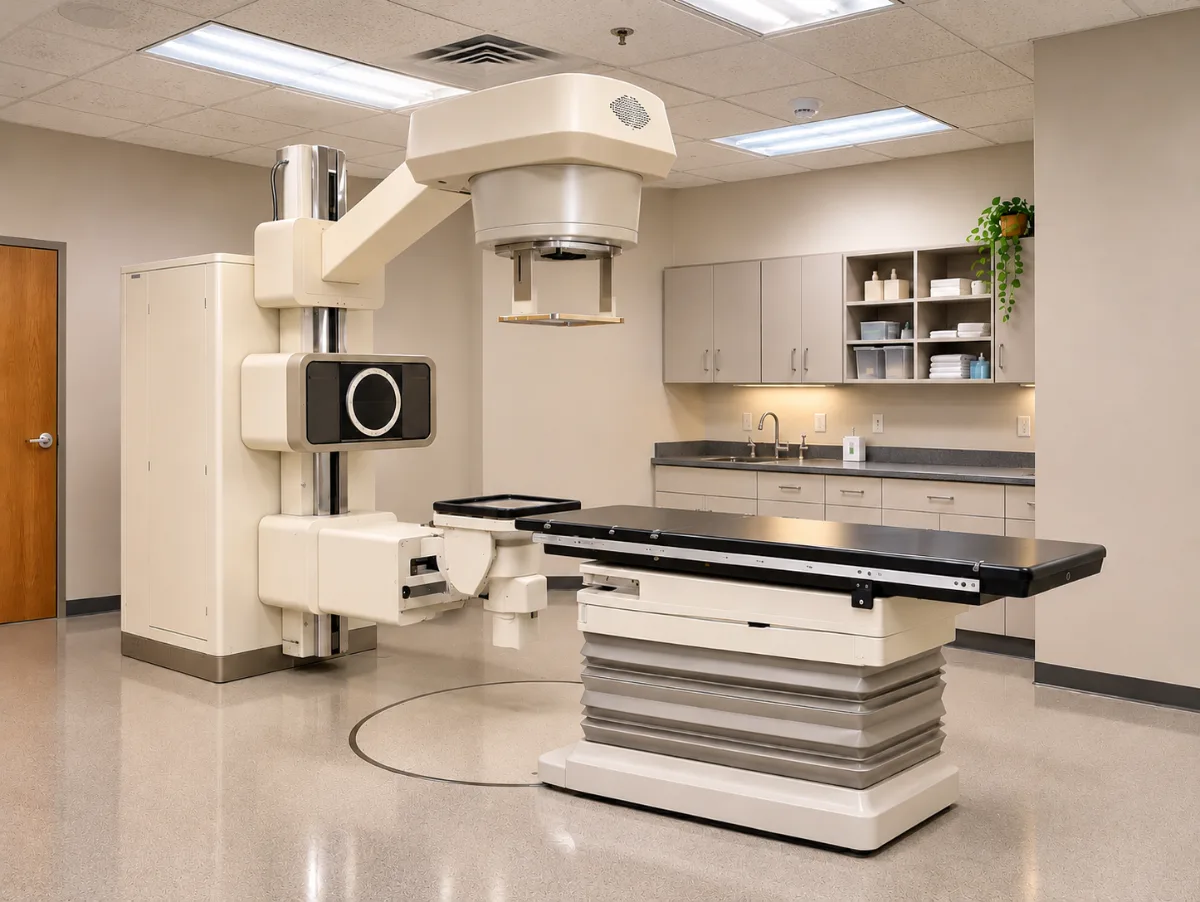
Linac Simulator Parts and Service
Conventional linac simulators are older equipment, but plenty of departments still run them five days a week. They’re used for field verification, and they cover when the CT sim is down. They’re also where residents and new therapists learn what isocenter really means, because you can stand right beside it and watch the gantry swing around. Newer planning workflows didn’t take any of that away.
The trouble is who you call when one quits. These machines need someone who understands the imaging chain and the isocentric mechanics — and those two skill sets used to live in the same person as a matter of course. Now they usually don’t.
What a Linac Simulator Does
A linac simulator reproduces the geometry of a linac without the dose. Same gantry rotation, same collimator rotation, same couch motion, same isocentric setup — but a diagnostic X-ray tube and fluoroscopy where the treatment head would be.
With that, you can find the target under fluoro, set field borders, shoot radiographs of the planned fields, and confirm angles and field sizes. It all happens outside the treatment vault, so the linac keeps treating patients.
Why Linac Simulators Are Still Running
CT simulation won, and for good reason. A large-bore scanner with virtual sim software — the Philips AcQSim, the widebore GE and Siemens configurations — gives you a volumetric data set. Once planning meant contoured volumes and DVHs, a two-dimensional fluoro image couldn’t compete.
Superseded isn’t retired, though. Plenty of departments never got the money for a replacement. Some hang on to a sim as a backup, so when the CT is down, nobody’s treatment gets pushed back. A few use them for teaching. And a clinic doing mostly simple fields may never need volumetric planning at all.
What all of those have in common: the parts stopped being manufactured years ago. Keeping the machine alive is a sourcing problem and a skills problem, in that order.
Simulator Platforms We Support
Varian, Nucletron/Oldelft (Simulix), AECL/Theratronics (Therasim), Shimadzu, Toshiba. Different mechanical designs, different control systems, different imaging configurations. General medical imaging experience doesn’t transfer cleanly — you want someone who has had the covers off the specific platform.
Buying a Used Ximatron
The Ximatron was Varian’s conventional sim and one of the most widely installed units of its generation. Plenty are still running, and plenty are changing hands on the secondary market.
A used Ximatron can be a good buy. Condition varies enormously, and the listing price tells you almost nothing about what you’re getting. Check these before money moves:
- X-ray tube and generator. Get the tube’s usage history. Confirm the generator puts out stable, accurate output rather than just powering up.
- Imaging chain. The image intensifier and the X-ray tube drive image quality and are among the most expensive parts to replace.
- Collimator and field delineation. Smooth travel, accurate readout.
- Lasers and optics. Aligned and holding alignment.
- Control electronics, software, and documentation. It should boot and run. Find out exactly which manuals and schematics come with it, because the ones that don’t are hard to get.
A pre-purchase inspection costs a fraction of what you’ll spend discovering a dead intensifier after you uncrate the unit and it’s sitting in your room.
Choosing a Linac Simulator Service Provider
- Component-level repair. This is the one that matters most and gets asked about least. Many simulator boards simply cannot be bought anymore. If your provider’s answer to a failed board is “we’ll order a replacement,” ask what happens when there isn’t one. The alternative is someone who can get to the component, find the fault, and fix the board in front of them.
- Radiation oncology experience specifically. Simulator work touches mechanical accuracy, radiation safety, and imaging performance all at once.
- Straight answers. What’s wrong, what it takes, how long you’re down.
Linac Simulator Parts and Service from 43 Oncology
43 Oncology sells parts and handles repairs and ongoing service for radiation oncology equipment, including linac simulators and used Ximatron units. Need a component right away? Got a unit that’s down? Thinking about buying a machine and want someone to look it over first? We can help with all three.